
Why I Quit My Job to Take Client Work
Why I left
Every programmer knows about the "30-year-old crisis." It's not that your skills decline. It's that your value for money, and what companies want, changes. The older you get, the higher your salary, and the more companies look for cheaper new hires. Promotions stall, income stops growing, and one day you're let go and realize you have nowhere to go.
I didn't want that. There's always demand for software development. The industry isn't going away, but companies do. The ones that last are studios with a good reputation.
Instead of grinding for one company with no say in it, I'd rather choose to grind for many.
So I decided to work with clients directly and take projects on my own. That way I don't depend on any single company, and the work doesn't dry up. It's a business for life, not a bet that I can still hold a job at a company after 30.
Once I had that thought, I left.
First project: a car charter mini program
My first project after quitting was referred by the tech director at my old company. A friend of his happened to need a car charter service, and knowing my work was solid, he introduced me.
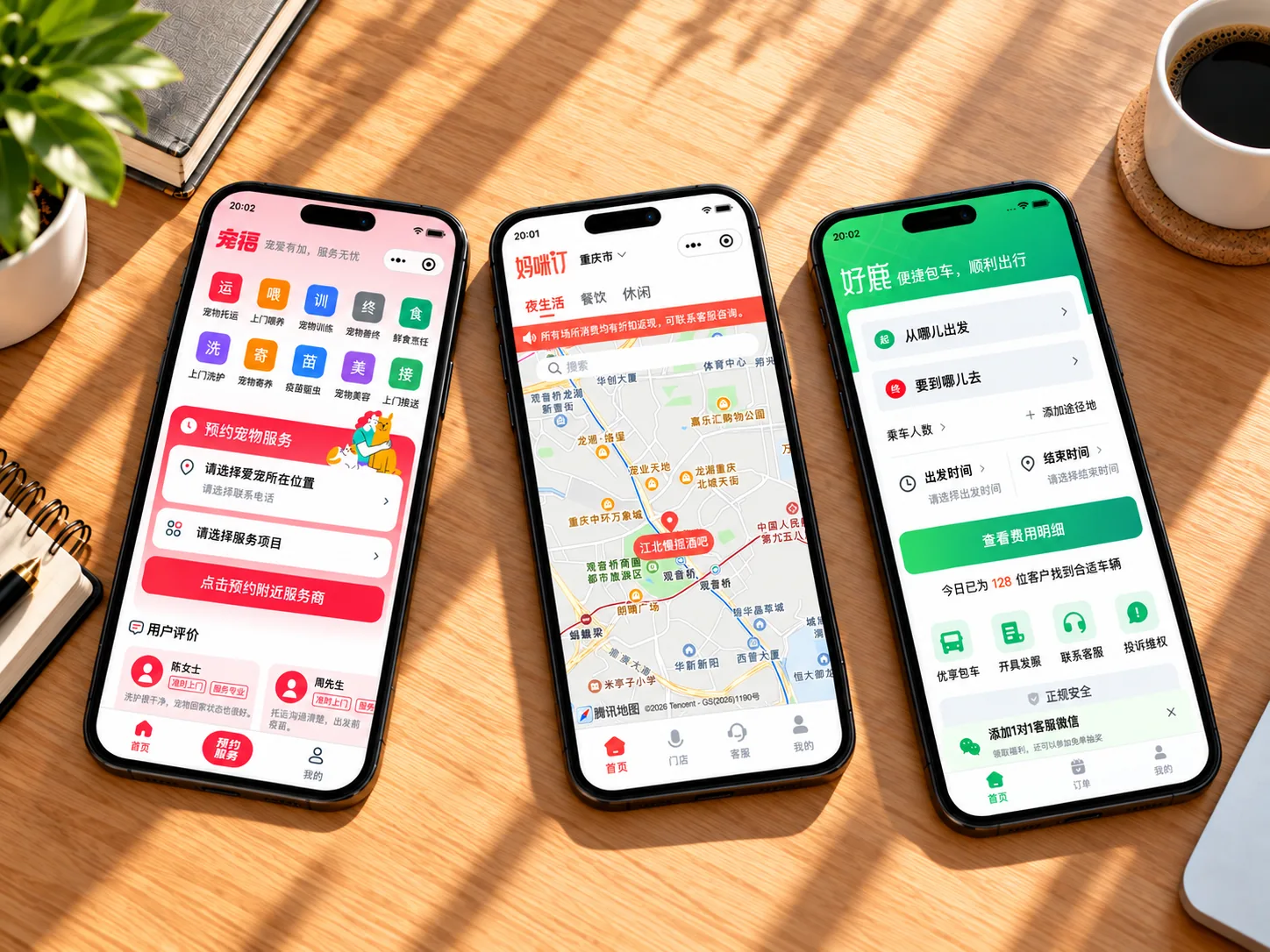
The car charter mini program has four core features: a vehicle catalog, location search, date booking, and online payment, so users can place an order quickly.
I asked him how it felt to use, and he said "fast." That's when I knew he understood the work: if he could feel the speed, he knew it wasn't simple.
When the first project was done, the client was very happy. Later he had two new projects, and he came back to me for both. In those same three months, I built 3 mini programs for him. The car charter one was just the first.
How he described me
One day after launch, chatting, he summed it up in a few points:
- The code matches the design exactly. Very faithful
- It's fast to use
- The back end uses high-performance Java
- And one more: strong technical skills
The first three are things he could see and feel. That last one is his judgment of me. What he meant was: this person's skills hold up, and he can solve problems.
How the work came in, one project at a time
In my first year after quitting, all my work came through referrals from friends or direct messages. Some came from people I'd met online, some from friends in my social circle, and some by word of mouth from past clients.
Why do clients come to me, especially the referred ones? Because once a client is happy with the work, they recommend me to their friends. Without that word of mouth, I'd never have landed the projects that followed.
That's why, when I quit, I made up my mind not to compromise on quality. If one project goes badly, the work after it disappears. A good reputation is what makes a business last. Over these years, I've seen that hold true.
Why I started writing in public
For these past few years, referrals and direct messages were enough to keep the business going. But I realized something: word of mouth grows slowly, and it has a ceiling.
I've got the whole delivery process working end to end. I know this industry well: how to get clients high-quality work at a reasonable cost, while I take a reasonable margin. That method and experience can be reused, and they're worth something.
Instead of waiting for clients to find me, I can tell them directly: which direction to take, how to control costs, how to make sure the quality holds. I can help them avoid a lot of mistakes and build a good product for ¥30,000 instead of ¥300,000.
That way, new work no longer comes only from referrals. It also comes from what I publish. The risk is spread out, and growth isn't capped anymore.
Linework Studio. Yubei, Chongqing.